Tuesday, 12 July 2016

Are US black separatist groups on the rise?


Black PanthersImage copyrightGETTY IMAGES

The Dallas gunman who shot and killed five police officers and injured seven others supported armed black militia groups, bringing to light a movement that has thrived in the wake of police shootings in recent years.
The gunman, 25-year-old Micah Xavier Johnson, was linked to black separatist groups including the New Black Panther Party for Self-Defense, the Nation of Islam and the Black Riders Liberation Party.
Before Johnson was killed by a bomb detonated by a police robot, he told negotiators he wanted to kill white police officers.
He also told police he acted alone and was not affiliated with any groups.
However, Johnson's online presence has revealed his enthusiasm for black separatist groups.
Though his affiliation with these groups is unclear, his Facebook profile photograph featured him raising a fist in salute to "black power", which is associated with the Black Panther Party movement, a radical political organisation that came to power in response to the 1960s US civil rights upheaval.
He also joined groups online that reference the Black Panther Party,
However, Johnson was reportedly "blacklisted" from many of the organisations that inspired him, the Daily Beast reported.

What are black separatist groups?

While activist groups such as Black Lives Matter have taken a central role in the US movement on police reform and racial justice, black separatist groups have used a more racist and militant approach.
Many black separatist "hate groups" are rooted in racism and anti-Semitism, according to the Southern Poverty Law Center's Heidi Beirich.
Ms Beirich tells the BBC these type of hate groups are different from typical white supremacy groups like the Klu Klux Klan, in that they are formed in reaction to societal white oppression.
Many of today's groups make reference to the original Black Panther Party, which carried out armed citizens' patrols to monitor police behaviour in California during the 1960s.
However, none are affiliated with the Black Panthers.
Though the Black Panthers promoted armed resistance early on in the movement, the group placed more emphasis on police patrols, according to Stanford Historian Clayborne Carson.
"They had decided that that kind of emphasis on the gun was counterproductive in terms of their ability to get support in the black community," he tells the BBC.
"In a sense the Black Panther Party police patrols were doing what video cameras do now," Mr Carson says. "If they had iPhones at that time, they would have not simply watched police but also recorded them."

New Black Panther Party membersImage copyrightAP
Image captionNew Black Panther Party members face off with police in Baton Rouge

Who are they?

The New Black Panther Party for Self-Defense (NBPP), founded in 1989 in Dallas, is one of the major black separatist groups in the US.
The group has a 10-point platform advocating the power to practise self-determination for a "black nation", the release of all black people in prison, an end to police brutality against black people, and a call for all black people to arm themselves for self-defence.
The SPLC and Anti-Defamation League have labelled the NBPP as a hate group "whose leaders have encouraged violence against whites, Jews, and law enforcement officers".
Black Panther co-founder Bobby Seale has called the NBPP's rhetoric "xenophobic" and "absurd".
The Nation of Islam (NOI) was founded in 1930 and is considered the oldest black nationalist group in the US.
While the group provides social service programmes to African American communities, the SLPC and Anti-Defamation League have branded it as a hate group founded in anti-Semitism and racism.
The Huey P Newton Gun Club, named after one of the Black Panthers' founders, was created last year in Dallas to oppose "police terrorism".
The group teaches self-defence and conducts patrols in areas where black men have died at the hands of police.
"Us arming ourselves, we're able to create a culture of being independent from government institutions who do not have our best interest in mind," said Rakem Balogun, a founding member of the gun club.
"When [white people] see us with guns, they see boys in the hood", he told the BBC's Dan Murdoch, "instead of thinking black deacons of defence".
Though Johnson was a member of the Huey P Newtown Gun Club's Facebook group, member Erick Khafre told the Los Angeles Times that he had no affiliation to the club "in any way".
Ms Beirich also notes the gun club is not counted as a SPLC hate group as it does not reinforce racist ideals.

How many are there?

In recent years, the high-profile police shootings of African Americans have fuelled the proliferation of black separatist groups, according to SPLC.
In 2015, US police shot and killed a civilian nearly 1,000 times, according to a year-long Washington Post study.
The deaths of Michael Brown, Eric Garner, Freddie Gray and more recently,Philando Castile and Alton Sterling are also among some of the cases that groups have used as an "organising tool" to illuminate the systemic problem with police racism, Ms Beirich says.
In response, the number of black separatist hate groups has jumped from 113 chapters in 2014 to 180 last year, SLPC reported.

What do they believe?

Each group carries different beliefs in relation to black power and white oppression. However, many black separatist groups are explicitly anti-white and tend to share a mistrust of government, according to Ms Beirich.
Some groups are also anti-Semitic and anti-gay, which could be attributed to rhetoric by the long-standing NOI.
The group's leader, Louis Farrakhan, has long espoused anti-Semitism and homophobic messages.
"These false Jews promote the filth of Hollywood that is seeding the American people and the people of the world and bringing you down in moral strength. … It's the wicked Jews, the false Jews, that are promoting lesbianism, homosexuality", Mr Farrakhan said in 2006.
"The group has left a stain on the radical black nationalist movement", Ms Beirich says, noting that many radicals may have started as NOI members and spiralled farther into extremism.
In contrast, the Black Lives Matter movement extends beyond the African American community.
"What's striking about the Black Lives Matter protest is how multi-racial they are," Mr Carson says. "It's probably one of the most multi-racial activities going on in the US."

More on this story

Religious intolerance, hate fingered in death of RCCG pastor Read more:

Editor’s note: Religion and religious fanaticism poses a threat to the existence of Nigeria as a nation. The killing of a pastor’s wife named Mrs Eunice Elisha has called for a new dialogue on the issue of crimes committed in the name of religion. What can Nigeria do about this controversial issue which might lead to the implosion which many fear is imminent. Share on Facebook Share on Twitter When on Saturday, July 9, Mrs Eunice Elisha went to spread the goodnews of Jesus, little did she know that an ill fate was awaiting her. Mrs Elisha did not know that she will get into some badnews that will forever leave her family in tears, a story that will leave so many questions on the lips of Nigerians and the world at large. According to reports, the pastor’s wife met with her untimely death at the hands of assailants yesterday, July 9. Born on July 23, 1974, 42-year-old Eunice Elisha was a deaconess at the Divine Touch parish of the Redeemed Christian Church of God, (RCCG) Old NEPA Road, Phase 4, Kubwa. She had gone out to evangelize along Gbazango-West area of Kubwa when she was hacked to death by unknown assailants suspected to be extremists. Sources revealed that the mother of 7 was cut in the neck and stabbed in the stomach and was left to bleed out. Her bible, megaphone and mobile phone were found on the floor beside her body, it was an eyesore, and there were no witnesses. Fowl play There were speculations that Mrs Elisha’s death was orchestrated by some Muslim fanatics. Developing reports suggest that the deceased had been treading on a very deadly path with regards to her evangelism. Unconfirmed sources report that Eunice had been preaching within the area that had a mosque, thereby stirring some trouble. The sources say the deceased had been warned severally to desist from preaching around the region, but she just won’t stop. There was a tale by the family suggesting that indeed it must be some people of the Muslim faith that murdered their mother. The husband of the deceased had told newsmen that a Muslim cleric once came to their house asking his wife to give him food, stating that he had an Islamic school and thus needed some food, she had told him there was no food in the house. Her second son John James corroborated the story, saying that his mother had sent him to tell the strange man that there was no food. According to James, after the strange man came to their house, the deceased suddenly took ill and almost died from the sickness, he also said his mother had insisted the sickness was caused by the mallam. A brief history of murder in religion’s name It remains unclear what the motive of the murder was, the police cannot say for certain that the killers of Mrs. Elisha were indeed Muslims. In a press statement released by the FCT command’s commissioner of police Alkali Baba Usman, the deputy commissioner of police in charge of the Criminal Investigation and Intelligence Department (CIID) has been assigned to lead an investigation into the murder case. Baba Usman also said the six suspects arrested in connection with the murder are currently undergoing interrogation in police custody.  He also assured that the outcome of the investigation will be made public. While commiserating with the deceased’s family, he reassured them of the police’s commitment and determination to bring the people involved in the murder, to justice. He also urged the residents of the area and members of the public to remain calm and aid the police with their investigations. However, some Nigerians are of the opinion that here is yet another promise that most likely will not be fulfilled, and the reasons are quite simply, the public has for too long lost faith in the Nigerian police force and their capabilities to grant justice to the oppressed and bringing law breakers to pay for their offences. Mrs Elisha’s case is not the hundredth of such a case, especially within the northeastern region of the country. There have been several cases of killing in relations to religious intolerance. READ ALSO: Former governor openly apologizes to Pastor Adeboye (see photos) Just recently, an elderly woman was reportedly murdered in Kano for making an unguarded statement which was termed as blasphemy. The woman named Mrs Bridget Agbaheme was stoned to death for what in the eye of the law was her right. Mr Agbaheme, husband to the deceased said his wife was stoned to death, he added that Bridget was attacked by religious fanatics at Kofar Wambai market in the state, after she allegedly told Muslims not to perform abolition at a certain spot. Mrs. Bridget who until her death was a member of the Deeper Life Church, was said to have defamed the name of the holy prophet. Till date, the police are yet to make any comment regards investigations into the murder of Mrs Agbaheme, like many other stories of such magnitude, it dies a very natural death after all the buzz on social media and every other platform where issues of such nature are discussed and debated. Nigeria’s biggest problem If one takes a very critical look at Nigeria, it won’t be hard to notice that the biggest trouble Nigeria has is the issue of religion. Virtually every problem the Nigerian government has had to tackle from the inception has been problems rooted in religion. Religion has for too long threatened to destroy Nigeria, and religion still threatens to see that the nation ceases to exit. Beginning from the civil war fought between 1967 and 1970, one can see the hand of religion in all that troubles the nation. It must be stressed that as at the time when the war was about breaking out, the Igbos saw themselves as the biblical Israelites who had to come out of Egypt a land of slavery and oppression. The Boko Haram insurgency which for a few years has really troubled Nigeria is deeply rooted in religion and religious fanaticism. Agitations with regards to the actualization of the Biafra Republic, is a concept that is founded on religious philosophies, the same religious idiosyncrasy which saw the emergence a civil war is the same experienced in the current movement and it has had its own fair share of bloodshed. Having tabled these facts, it won’t be out of place to say that Nigeria’s biggest problem is the problem of religion. Who killed the pastor’s wife? Having spent decades in Nigeria, and having come in terms with the reality of the concept called Nigeria, it would stupid of me to be on the lookout for news of how the police have apprehended the killers of the Mrs Elisha. I’ll rather be willing to find a permanent solution to this huge problem that might eventually lead to the end of Nigeria’s existence. Religion was the reason Mrs Elisha was killed, it was carried out with Ignorance, and hate playing accomplice to murder. It’s no news that so many around the world are killed on a daily basis because of faith and religion. However, I maintain that religion is not a bad thing in itself, but those who practice the various religious often practice to their detriment and the detriment of others. How do we arrest the killers? First it is high time the federal government stopped paying lip service when issues of this proportion are to be treated. It is not ok to say the presidency condemned the attack, after the condemnation, what follows? What parameters are put in place to ensure that such ugly incidents do not occur again, any time soonest at least. The Nation must go back to the basis and correct the ills of not operating under the rule of law. If foreigners say we are a lawless people, then they are right to a large extent. We know that virtually anything goes in Nigeria, the courts have lost and are still losing the faith of the people in their capability to deliver just judgments. So much are being done outside the books these days, hence there is a fear that soon there will be no one with a high moral standing to set the records straight. Nigerians need re-orientation generally, enlightenment and education is also needed because so many Nigerians have lost their minds, and some do not know what is right and what is wrong. If in this time and age, jungle justice still Rationality and faith must find a meeting place, and this is the job of the scholars, teachers and clerics in citadels of learning and religious places. We cannot continue to act on impulse; there must be some serious contemplation with regards to our actions, reactions, and dealings with fellow Nigerians. It is time to approach issues in this country not as Igbo, Hausa or Yoruba, it is high time we stopped approaching issues in Nigeria, as Christian, Muslims and every other label that religion takes. READ ALSO: Trouble in Nigeria: Buhari declares war, militants threaten – Top 15 quotes We must approach all our problems first as Nigerians; we must be patriotic, having at the back of our hearts the greatest good of our country over our selfish needs and ambition. Nigeria has been described as the giant of Africa standing on chopstick legs, the nation has been described a country sitting on gunpowder, there are fears that an implosion is imminent. Religion is threatening to tear the nation apart, with various beliefs so diverse; we need respect as a people. We must tolerate and respect everyone’s faith. The freedom of worship which we enjoy should not be a pass to infringe on some other person’s belief thereby tampering with their emotions. How about we organize evangelistic exercise in such a way that others will not find it obnoxious? How can we preach without necessarily casting aspersions on another’s religion? Love is a key message that cuts across all religions, how come we leave that out when matters arise? Mrs Elisha is dead and gone, but who will be next? Who will be the next person to be lynched by an irate crowd, just because he or she is not of the same belief? When do we hear the last of jungle justice and fighting for god? I must note here that revenge is not the solution to the matter at hand, Christians who are aggrieved by the incident must try to remain calm, knowing that violence is not the way to go. Nigeria can remain a united country though so diverse in culture, tradition and religion, but that’s only  if we would respect eachother’s views, ensuring that everyone is treated as relevant regardless of their being from major tribes or belonging to the minority. Everyone must be given what is due, regardless what god or gods they worship; let us imbibe the culture of placing Nigeria first. This article expresses the authors’ opinion only. The views and opinions expressed here do not necessarily represent those of Naij.com  Your own opinion articles are welcome at info@naij.com — drop an email telling us what you want to write about and why. More details in Naij.com’s step-by-step guide for guest contributors. We’re ready to trade your news for our money: submit news and photo reports from your area using our Citizen Journalism App. Contact us if you have any feedback, suggestions, complaints or compliments. We are also available on Facebook and Twitter. Subscribe to Naij.com Opinion page!

Micah Johnson: Dallas killer 'changed' by military experience


Images from the Facebook page of Micah Johnson showing him giving a 'black power' saluteImage copyrightFACEBOOK
Image captionFacebook images show Micah Johnson giving a 'black power' salute

The gunman who killed five police officers in Dallas was "changed" by his experience in the US military, his mother has said.
Micah Johnson went from being an extrovert to a "hermit", Delphine Johnson told The Blaze website.
"The military was not what Micah thought it would be," she said. "He was very disappointed."
Johnson opened fire at a protest being held over the deaths of African Americans at the hands of police.
The demonstrations, echoed nationwide, followed the police killings of Philando Castile in Minnesota and Alton Sterling in Louisiana.
Bomb-making material, rifles and a combat journal were found at the home of Johnson, who was himself killed.
"I don't know what to say to anybody to make anything better. I didn't see it coming," James Johnson, his father, told the website.
"I love my son with all my heart. I hate what he did."

Micah Johnson, handout picImage copyrightAFP
Image captionMicah Johnson left the initials 'RB' written in his own blood, police say

Dallas police chief David Brown said all of the officers are on edge after the events and that his family has received death threats.
He said 13 officers used force against Johnson during the stand-off, in which Johnson was killed by a robot bomb.
Killing Johnson was "not an ethical dilemma", he said.
"I'd do it again" to protect fellow officers, he said.

Media captionMillennials worry about what's in store for the next generation of black Americans
Mourners at a police car in DallasImage copyrightGETTY IMAGES
Image captionFive police officers were killed in the attack

The events will not discourage the department, Mr Brown said, which has seen 12 consecutive years of crime reduction in Dallas.
"We're going to turn over every rock" to make sure Johnson was the only person planning the attack, he said, and that the department is following "any and all leads".
Mr Brown suggested angry young black people in the US join their local police departments and try to become "part of the solution".
"We're hiring," he said. "Get off the protest line and put in an application."

Ieshia Evans faces armed policeImage copyrightREUTERS / JON BACHMAN

A picture featuring a woman in a dress standing calmly before two heavily body-armoured police officers during a Black Lives Matter protest in Baton Rouge, Louisiana, is circulating on social media.
The woman, Ieshia Evans, responded on Facebook, saying: "I appreciate the well wishes and love, but this is the work of God. I am a vessel!"
Republican presumptive presidential nominee Donald Trump, speaking at a campaign event on Monday, mentioned the events in Dallas and said it's "time for hostility against police and all law enforcement to end immediately".
"I am the law-and-order candidate," he said.
Presumptive Democratic presidential nominee Hillary Clinton, speaking last week at the Emanuel AME church where nine worshippers were killed last summer, said bias exists in some police departments.

US releases $13million for Boko Haram victims in North East Read more:

– Internally Displaced Persons in the Northeast of Nigeria are set to receive $13m as life-saving support from the United Nations – – UN says the humanitarian crisis in North-East Nigeria is massive and alarming – UN says 15 million people are affected by the violence instigated by Boko Haram including seven million people who need urgent humanitarian assistance Following the increasing rate of Internally Displaced Persons, refugees and returnees, the United Nations Humanitarian agency on Monday, July 11, announced the release of  $13 million from the Central Emergency Response Fund (CERF) to provide life-saving assistance to 250,000 persons in Northeast of Nigeria that have just become accessible. According to a report on Vanguard, the CERF funding will help more than 50,000 persons rebuild their livelihoods by providing food, including the all-important child nutritional supplements.
Read more:

US releases $13million for Boko Haram victims in North East In a statement by Stephen O’Brien, on behalf of the UN agency, the humanitarian group says the international community must take advantage of the better access to vulnerable people, in order to reach them with essential services and build on the CERF allocation to scale up the response. READ ALSO: FG delegation visits IDPs in camp Bama “The humanitarian crisis in North-East Nigeria is massive and alarming: 15 million people are affected by the violence instigated by Boko Haram including seven million people who need urgent humanitarian assistance,” said Munir Safieldin, the acting Humanitarian Coordinator. The released $13 million brings the total CERF support to more than $70 million. $27 million was allocated in March 2015 to assist more than 1.6 million Internally Displaced Persons, IDPs, refugees, returnees, and host communities in Cameroon, Chad, Niger and Nigeria. While an additional $31 million was provided in early 2016 to help 700,000 people in the Lake Chad Basin. READ ALSO: Feature: How rescued Boko Haram captives die in IDP camps Today, there are over 2 million IDPs mostly women and children, from the insurgency in northeast Nigeria and another 80,000 taking refuge in neighbouring Cameroon, according to figures from the Nigerian Emergency Management Agency (NEMA). Recent reports of famine in camps for IDPs have raised concerns within and outside the country. In a camp in Bama, a town in Borno state, 200 children were reported to have died from hunger, while many suffer from malnutrition. According to Laolu Akande, the senior special assistant to the vice-president on media and publicity, at least 20,000 people were killed by Boko Haram between 2011 and 2015 in Nigeria. Borno state has been worst hit by the crisis with a loss of $6bn while Yobe and Adamawa states were next in devastation. The northeast region suffered damage worth $3bn in housing alone, while it also suffered huge damage in terms of livestock which brought about the need to restore agriculture in the region

International tribunal to make South China Sea ruling


Chinese dredging vessels are purportedly seen in the waters around Mischief Reef in the disputed Spratly IslandsImage copyrightREUTERS
Image captionChina has accelerated construction on some disputed reefs

An international tribunal is set to give a long-awaited ruling, with implications for China's controversial claims in the disputed South China Sea.
The case at the tribunal in The Hague was brought by the Philippines, which argues Chinese activity in the region is against international law.
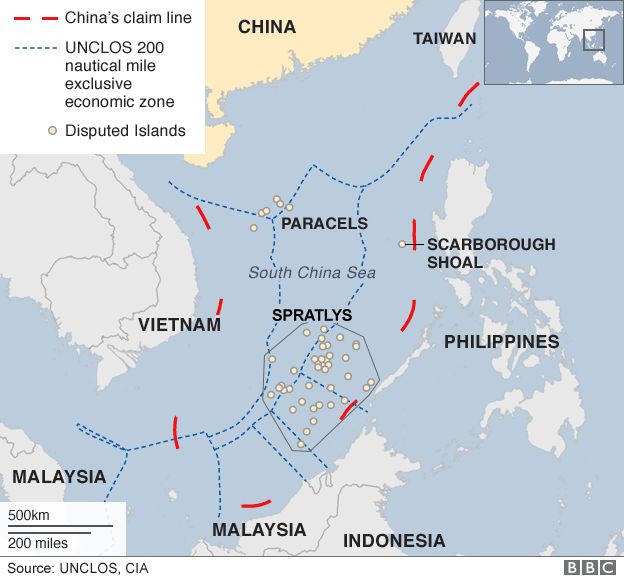
China claims about 90% of the South China Sea, including reefs and islands also claimed by others.
China says it does not recognise the tribunal and has refused to take part.
The case is being decided by an arbitration tribunal under the United Nations Convention on the Law of the Sea (UNCLOS), which both countries have signed.
The ruling is binding but the tribunal has no powers of enforcement.

Media captionThe BBC's Jonah Fisher explains the huge legal implications of how the disputed South China Seas islands are classified

However, observers say it could favour the Philippines - and China risks reputational damage if it does not abide by it.
They also warn there is a risk that China could react aggressively to a ruling against it.
The US has sent an aircraft carrier and fighter jets to the region in anticipation of this, prompting an angry editorial in the Global Times, a strongly nationalist state-run newspaper, calling for the country to prepare for "military confrontation".
Meanwhile the Chinese Navy has been carrying out exercises near the disputed Paracel islands.

South China Sea

The tribunal hearing the case has previously said it is the appropriate body to rule on at least seven of the 15 claims in the Philippines' case and was still considering the other eight.
Beijing has been trying to gather international support for its view that the tribunal's ruling should be rejected.
Chinese diplomats have written a slew of articles setting out their government's position in English-language media around the world.
China says about 60 countries support its stance that the tribunal's ruling should be rejected, but few have declared their support publicly.

Chinese missile frigate Yuncheng launches an anti-ship missile during a military exerciseImage copyrightAP
Image captionChinese ships have been on naval exercises ahead of the ruling


What is the tribunal about?

PeopleImage copyrightREUTERS

The Philippines brought a case in 2013 to the UNCLOS tribunal, contesting China's claims and activity in the South China Sea, saying that they were contrary to international law. It has accused China of interfering with fishing, dredging sand to build artificial islands and endangering ships, among other claims.
It also asked the tribunal to reject China's claims to sovereignty over waters within a "nine-dash line", the dotted boundary that claims as much as 90% of the South China Sea, that appears on official Chinese maps.
What is the impact of its ruling?
According to Bill Hayton, author of South China Sea: The struggle for power in Asia, a large part of the case is about asking the court to decide what specific land features in the area are, and therefore how much claim to territory each country has.
  • Low-tide elevations, or reefs, which are visible only at low tide, get no territorial waters,
  • Rocks, which are defined as anything above water at high tide regardless of size, get a 12-nautical mile limit of water around them
  • An island, which is able to "sustain human habitation or an economic life of its own", is given a 200-nautical mile exclusive economic zone around it.
Therefore, if the tribunal rules that nothing that China occupies in the Spratly Islands is a proper island, it will be unable to claim land rights of 200 nautical miles.

Media captionThe BBC's John Sudworth went to track down the famed 600-year-old book

Although the ruling is binding, the UN tribunal has no powers of enforcement. However, the ruling could set a precedent for similar cases in future.
Will it make a difference?
China has boycotted the tribunal, saying that the panel has no jurisdiction. It has already said it will not "accept, recognise or execute" the decision.

Media captionChina's tours in disputed South China Sea

However, if the ruling favours the Philippines, China could risk reputational damage and be portrayed as a country that ignores international law, perhaps leading to greater tensions between China and the Philippines, or the US, which has sent significant military assets to the area.
The Philippines' new President Rodrigo Duterte has said his country is willing to share natural resources with Beijing in contested South China Sea areas even if the tribunal rules in its favours.
Mr Duterte has adopted a more conciliatory approach to China than previous president Benigno Aquino, and it remains to be seen how the ruling will affect the two countries' relations.

Search This Blog

Brexit: EU negotiator says 'time's short' for reaching deal

Jump media player Media player help Out of media player. Press enter to return or tab to continue. Media caption Mic...