Tuesday, 12 July 2016

Tribunal to rule in South China Sea row


women and children sitting on the ground in front of a UN truckImage copyrightBEATRICE MATEGWA/ UNMISS
Image captionThousands of civilians have been forced to shelter on UN premises

The United States has said an outbreak of violence that has left hundreds dead in South Sudan "must stop".
Anyone impeding efforts to end the fighting would be held fully accountable, the White House warned.
The UN has called for an immediate arms embargo, as well as attack helicopters to strengthen its peacekeeping force.
Days of fighting between forces loyal to President Salva Kiir and Vice-President Riek Machar in the capital, Juba, has left hundreds dead.
A ceasefire was called on Monday but it is not clear whether the violence has subsided. Heavy gunfire continued to be heard in the capital after President Kiir's ceasefire order came into effect at 1800 local time (1500 GMT) on Monday.
Two Chinese UN peacekeepers and one South Sudanese UN worker are among the hundreds of dead.
The US's National Security Adviser, Susan Rice, said: "This senseless and inexcusable violence - undertaken by those who yet again are putting self-interest above the well-being of their country and people - puts at risk everything the South Sudanese people have aspired to over the past five years."

Peace deal shredded

South Sudan became independent from Sudan in 2011 but its short history has been marred by years of civil war.
The BBC's James Copnall says the latest clashes have traumatised Juba and shredded a peace deal between Mr Kiir and Mr Machar, agreed last August.
He said there were also doubts over how far both men were in command of their forces. Both leaders had called for calm last Friday, but the fighting carried on.
Thousands of people have had to leave their homes.
Hundreds of them have sought refuge in UN premises, including Jebel and Tomping bases in Juba which were caught in crossfire on Monday.

two children, one about 5 and the other about 12 years old, eating from a plate of rice while sitting on blankets surrounded by other people, 11 JulyImage copyrightBEATRICE MATEGWA/ UNMISS
Image captionSome people took shelter at a UN compound in Juba

UN Secretary-General Ban Ki-moon said: "Yet again, the leaders of South Sudan have failed their people. Rarely has a country's conduct squandered so much promise so quickly."
Mr Ban said an "immediate" arms embargo should be imposed on South Sudan, political and military leaders blocking the peace deal should be sanctioned and the UN mission to the country should be fortified.
He also called for military equipment "to fulfil our mandate to protect civilians" and said countries with troops in South Sudan should "stand their ground" rather than withdraw in the face of the violence.
On Monday afternoon, an army spokesman told the BBC that soldiers loyal to Mr Kiir had been ordered back to barracks.
Any who resisted the order, by loitering or looting, would be arrested, he said.

South Sudan Riek Machar, left. Salva Kiir, South Sudan President, right, on 8 JulyImage copyrightAP
Image captionVice-President Riek Machar, left, and President Salva Kiir have been locked in a power struggle
Media captionWhat's happening in South Sudan?


Why has fighting resumed?

It seems a disagreement at a checkpoint between rival soldiers led to a shootout on Thursday night in which five soldiers died. This quickly escalated into serious fighting from Friday onwards. Tensions have been high since April, when Mr Machar returned to Juba under a peace deal following a two-year civil war. He took a 1,300-strong protection force with him and they were supposed to start joint patrols with forces loyal to President Kiir. But a lack of trust between the two sides means the patrols have not begun.

Will it become a new civil war?

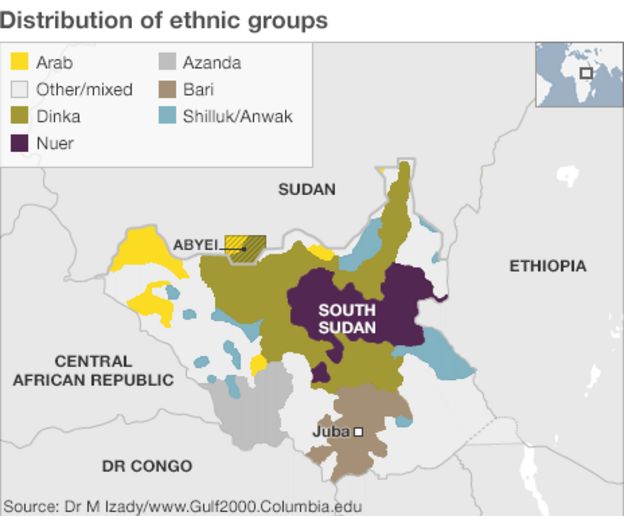
There are concerns that what we are seeing is a repeat of what happened in December 2013. The two-year civil war started after clashes between rival soldiers in Juba and degenerated into nationwide conflict in which tens of thousands died. The war was fought broadly between South Sudan's biggest ethnic groups - the Dinka, led by Mr Kiir, and the Nuer, under Mr Machar.

What can the international community do?

The international community played a major role in the creation of South Sudan and has tried to exercise some influence since independence in 2011. The UN and US have called for an immediate end to fighting, a call echoed by the East African regional group which brokered the recent peace deal.

UN armoured personnel carrier in JubaImage copyrightAP
Image captionUN peacekeepers have suffered casualties in the clashes


News graphic showing the ethnic groups of South Sudan
Image captionThere is no dominant culture in South Sudan - the Dinka and the Nuer are the largest of more than 60 ethnic groups, each with its own language and traditional beliefs, alongside Christianity and Islam

Monday, 11 July 2016

South Sudan police and soldier stand guard on Juba street - 10 July Explosions and gunfire rock South Sudan


South Sudanese watch Riek Machar on TVImage copyrightREUTERS
Image captionMr Machar spoke on television following renewed clashes in Juba

Renewed fighting has broken out in South Sudan between forces loyal to the president and vice-president.
A reporter in the capital, Juba, told the BBC gunfire and large explosions could be heard all over the city; he said heavy artillery was being used.
More than 200 people are reported to have died in clashes since Friday.
The latest violence came hours after the UN Security Council called on the warring factions to immediately stop the fighting.
In a unanimous statement, the council condemned the violence "in the strongest terms" and expressed "particular shock and outrage" at attacks on UN sites. It also called for additional peacekeepers to be sent to South Sudan.
Chinese media say two Chinese UN peacekeepers have now died in Juba. Several other peacekeepers have been injured, as well as a number of civilians who have been caught in crossfire.
The latest round of violence erupted when troops loyal to President Salva Kiir and first Vice-President Riek Machar began shooting at each other in the streets of Juba.
Relations between the two men have been fractious since South Sudan won independence from Sudan in 2011.
Their forces have fought a civil war.
But despite a peace deal last year ending the conflict, both sides retain their military capabilities and have continued to accuse each other of bad faith.

Media captionJapan's Ambassador to the United Nations, Koro Bessho: "The Security Council members urged an immediate end to the fighting"

'Under control'

A UN spokeswoman in Juba, Shantal Persaud, said fighting over the past few days had caused hundreds of internally displaced people to take refuge in UN premises.
She said both South Sudanese leaders were responsible for implementing last year's peace agreement, which included a permanent ceasefire and the deployment of forces away from Juba.
Information Minister Michael Makuei told the BBC that the situation in the city was "under full control" and civilians who had fled should return to their homes.
Mr Machar's military spokesman, Col William Gatjiath, accused officials loyal to the president of lying, and said there had been at least 10 hours of clashes on Sunday.
"The situation in South Sudan is uncontrollable because Salva Kiir and his followers are not ready to follow the peace agreement," he said.

Mr Machar (l) and Mr KiirImage copyrightAFP
Image captionGunfire erupted shortly after Mr Machar (L) and Mr Kiir (R) met on Friday

In a statement on Sunday, the US state department said it strongly condemned the latest outbreak of fighting in Juba.
Spokesman John Kirby said Washington had ordered the departure of non-emergency personnel from the US embassy in Juba.
Mr Kiir and Mr Machar had met at the presidential palace on Friday and issued a call for calm.
Calm was apparently restored on Saturday but heavy gunfire broke out again on Sunday near a military barracks occupied by troops loyal to Mr Machar.
A US academic who studies Sudan, Eric Reeves, told the BBC Mr Machar was trying to orchestrate a coup against his rival, with the backing of President Omar Bashir of Sudan.
"This has been planned," he said. "That violence now seems to be part of a co-ordinated coup led by Riek Machar. This changes entirely the complexion of the crisis."

How did we get here?


Cattle in South SudanImage copyrightGETTY IMAGES
Image captionSouth Sudan's short history has been marked by violence and poverty

July 2011 - South Sudan becomes an independent country, after more than 20 years of guerrilla warfare, which claimed the lives of at least 1.5 million people and displaced more than four million.
December 2013 - Civil war breaks out after President Salva Kiir sacks the cabinet and accuses Vice-President Riek Machar of planning a coup. The war is fought broadly between the country's biggest ethnic groups - the Dinka, led by Mr Kiir, and the Nuer, under Mr Machar.
More than 2.2 million people are displaced by the fighting. Famine puts the lives of thousands at risk. Tens of thousands of people are reported killed, and Mr Machar flees the country.

News graphic showing the ethnic groups of South Sudan
Image captionThere is no dominant culture in South Sudan - the Dinka and the Nuer are the largest of more than 60 ethnic groups, each with its own language and traditional beliefs, alongside Christianity and Islam

August 2015 - President Kiir signs a peace deal with rebels after a threat of sanctions from the UN.
April 2016 - Mr Machar returns to South Sudan to take up his job as first vice president in a new unity government led by President Kiir.
The move marks "the end of the war and the return of peace and stability to South Sudan", Mr Kiir says.

Search This Blog

Brexit: EU negotiator says 'time's short' for reaching deal

Jump media player Media player help Out of media player. Press enter to return or tab to continue. Media caption Mic...