Wednesday, 13 July 2016

Italian PM Renzi visits Puglia train crash site


PM Matteo Renzi speaking to emergency workers, July 12 2016Image copyrightEPA

Italy's Prime Minister, Matteo Renzi, has visited the site where at least 25 people died in a head-on collision between two passenger trains.
Many more people are injured and some are in a critical condition. Local authorities have appealed for people to give blood.
Mr Renzi has ordered an official investigation in to the crash, which happened on Tuesday morning.
The trains were on a single-track line between the towns of Bari and Barletta.
It was unclear what led to the collision, which happened in good weather at 11:30 local time (09:30 GMT) in the southern region of Puglia.

Italian train crash scene near AndriaImage copyrightITALIAN FIRE SERVICE
Image captionSeveral carriages were completely destroyed in the head-on collision on a single-track line
crumpled carriage with broken windows and debris strewn about, 12 July 2016Image copyrightITALIAN FIREFIGHTERS/ AP
Image captionThousands of people travel on the line every day
Mr Renzi walking alongside members of the emergency services, 12 July 2016Image copyrightEPA
Image captionAbout 200 people have been involved in the rescue operation, working in high temperatures

Rescue workers from the emergency services have been trying to free passengers from the shattered carriages and one small child was pulled out and airlifted to hospital.
Mr Renzi said it was "a moment for tears".
He said: "I want to express my condolences to the families and I have ordered, with no holding back, an inquiry to find who is responsible.
"I think we must have absolute clarity on this. We will not stop until we understand what happened."
Italy's President Sergio Mattarella said the crash was "an unacceptable tragedy" and his "first thought" was with victims and their families.

The BBC's Dan Johnson reports from the scene:

Under floodlights, heavy machinery is pulling pieces of wreckage from the line as rescue teams check for any more bodies.
It looks like the recovery effort will continue round the clock.
Even the army has been brought to the olive groves on this remote stretch of rural line.
From some of the carriages there is very little left that is recognisable - this was a powerful, sudden impact at high speed.
This line is privately run with a decent safety record. So the key question is how did two trains end up on the same piece of track speeding towards each other?


Media captionThe trains collided on a single track near the town of Andria, northwest of Bari

Both trains had four carriages and some were so badly damaged by the crash that there was little left but debris.
"I saw dead people, others who were begging for help, people crying. The worst scene of my life," one policeman told journalists.
Italian media reported that the first named victim was a 53-year-old policeman called Fulvio Schinzari, whose body was found by a fellow policeman who was helping the rescue services.
In total, about 200 were involved in the rescue operation, working in temperatures up to 40 degrees C (104 degrees F).

Matteo Renzi gripping the head of Michele Emiliano and speaking to him face to face, July 12 2016Image copyrightEPA
Image captionMatteo Renzi (right) met the governor of Puglia, Michele Emiliano, when visiting the site


Italy's deadly train accidents

June 2009: Freight train carrying liquefied petroleum gas derails in Viareggio, causing a large explosion. More than 30 people die
January 2005: A head-on collision between a passenger and a freight train near Crevalcore kills 17
July 2002: A passenger train derails in Rometta Messina, killing eight people
April 1978: Two trains collide near a ravine next to Murazze Vado. Some of the carriages fall into the gorge, killing 42
Sources: Ansa, Corriere della Sera

Hundreds forcibly disappeared in Egypt crackdown, says Amnesty


Egyptian police special forces patrol streets in al-Haram district of Giza on 25 January 2016Image copyrightAFP
Image captionPolice special forces patrolled the streets of Cairo on the fifth anniversary of the 2011 uprising

Egypt's security services have forcibly disappeared and tortured hundreds of people in the past year in an effort to wipe out dissent, a rights group says.
Students, political activists and protesters - some as young as 14 - have vanished without a trace, according to a new report by Amnesty International.
Many are alleged to have been held for months and often kept blindfolded and handcuffed for the entire period.
Egypt's government has denied it uses enforced disappearances and torture.
Interior Minister Magdy Abdul Ghaffar has insisted the security services operate within a framework established by Egyptian law.
More than 1,000 people have been killed and 40,000 are believed to have been jailed since President Abdul Fattah al-Sisi led the military's overthrew of Mohammed Morsi, Egypt's first democratically-elected head of state, in 2013.

Prosecutors 'complicit'

Amnesty's Middle East and North Africa director, Philip Luther, said enforced disappearances had become a "key instrument of state policy" under Mr Sisi and Mr Abdul Ghaffar, who took office in March 2015.

Egyptian Interior Minister Magdy Abdul Ghaffar speaks during a news conference in Cairo on 6 March 2016Image copyrightAFP
Image captionInterior Minister Magdy Abdul Ghaffar says its forces operate within a framework of Egyptian law

Citing local non-governmental organisations, Amnesty said that on average three to four people per day had been seized, usually when heavily armed security forces led by the National Security Agency (NSA) stormed their homes.
Hundreds of people were thought to be held at the NSA's offices, inside the interior ministry's headquarters at Cairo's Lazoughly Square.
Mr Luther said the report exposed collusion between the security services and judicial authorities, who he alleged had been "prepared to lie to cover their tracks or failed to investigate torture allegations, making them complicit in serious human rights violations".
One of the cases in the report is that of 14-year-old Mazen Mohamed Abdallah, who was taken from his home in the Nasser City district of Cairo by NSA agents on 30 September and accused of being a member of the outlawed Muslim Brotherhood and participating in unauthorised protests.

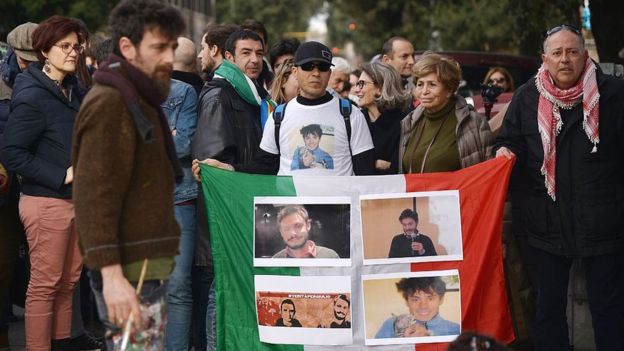
People hold an Italian flag with photos of Giulio Regeni during a demonstration in front of the Egypt's embassy in Rome on 25 February 2016Image copyrightAFP
Image captionAmnesty said it had found "clear similarities" between Giulio Regeni's injuries and those of Egyptians who had died in custody

Mazen said that after he denied the charges, interrogators repeatedly raped him with a wooden stick in order to force him to "memorise" a false confession, applied electric shocks to his genitals and other parts of his body, and threatened to arrest his parents if he retracted the confession.
The boy retracted the confession when questioned by a prosecutor, but was still charged and only released from custody on 31 January to await trial, Amnesty said.
Another of the cases featured in the report is that of Italian student Giulio Regeni.
The 28-year-old Cambridge University PhD student was found dead on a roadside on the outskirts of Cairo in February, his body bearing signs of torture.
The Egyptian authorities have denied any involvement in his killing, but Amnesty said its report had found "clear similarities" between his injuries and those of Egyptians who had died in custody.

Dallas shooting: Obama urges US to 'reject despair'

https://gooyaabitemplates.com/glooger-responsive-blogger-template/Jump media player

Media captionObama reflects on role as 'consoler-in-chief' during Dallas speech

President Barack Obama has urged the US to "reject despair" as he paid tribute to five police officers killed during a deadly sniper attack in Dallas.
He told a memorial service in the city the US must "try to find some meaning amidst our sorrow" and could unite.
His trip came amid mounting racial tensions across the country.
Micah Johnson killed the Dallas officers at a protest held over the recent police shootings of African Americans in Minnesota and Louisiana.
Before he was killed by police, he said he was angry about the shootings.
Meanwhile, protests over excessive police force against black Americans have been held in cities across the US.
But speaking at Morton H Meyerson Symphony Center in Dallas on Tuesday, Mr Obama urged the country not to despair.
Americans are struggling with what has happened in the past week, he said, and events appeared to have revealed "the deepest fault line of our democracy".
"I'm here to say we must reject such despair. I'm here to insist that we are not as divided as we seem."
He honoured the bravery of police officers and said fewer people were being mourned at the service because of the courage of the officers killed.
The service featured five portraits of the officers and five empty chairs.
Ex-President George W Bush, a Texan, praised the police: "Their courage is our protection and shield."
And Dallas Mayor Mike Rawlings, who spoke first, said: "The soul of our city was pierced."
First Lady Michelle Obama, Vice President Joe Biden and his wife, Jill, will also meet privately with the families of the victims on Wednesday.

Pictures of the five fallen officersImage copyrightAP
Image captionPictures of the five fallen officers were central to the service
Barack Obama hugs Police Chief David BrownImage copyrightEUROPEAN PHOTOPRESS AGENCY
Image captionPolice Chief David Brown received a standing ovation when he was introduced
George W BushImage copyrightAFP
Image captionGeorge W Bush praised the courage of the police
Supporters participate in the Dallas Strong Candlelight Vigil in TexasImage copyrightEPA
Image captionThe city held a candlelight vigil to remember the slain officers

Dallas police have ramped up security ahead of the president's visit, enlisting help from the Arlington Police Department to work with Secret Security.
The US has been on edge in the wake of the recent string of violence, with protests over police reform and race relations roiling across the country.
And Mr Obama has been criticised for not doing enough to support the police, many of whom say they feel under attack because of the protests and criticism.

Reaction to President Obama's speech

  • Nicholas Kristof of the New York Times called the speech "excellent" and that Mr Obama is "so eloquent on race"
  • Conservative talk radio host Dana Loesch said it was good until it became "a partisan political lecture on gun control, race, and policing"
  • Domenico Montanaro of NPR News called it the biggest race speech of Mr Obama's presidency
  • Conservative political operative Tim Miller said Mr Obama and George Bush's speeches had "hope, dignity and constructiveness"

Mr Obama and Mr Biden on Monday met with law enforcement officials to discuss police reform and how to repair relations between police officers and the communities they protect.
The president, who cut short a trip to Europe over the recent violence, is expected to host a similar meeting on Wednesday in Dallas with law enforcement as well as local leaders and activists.

Media captionPresident Obama: "I believe our sorrow can make us a better country"
Media captionMillennials worry about what's in store for the next generation of black Americans


Search This Blog

Brexit: EU negotiator says 'time's short' for reaching deal

Jump media player Media player help Out of media player. Press enter to return or tab to continue. Media caption Mic...